
Most people start strength training because they want something tangible: more muscle, less body fat, better posture, fewer aches, more energy, or the confidence to walk into a room feeling capable. Those are excellent reasons.
But if you stay with strength training long enough, you discover something bigger.
Strength does not only change your body. It changes how you carry yourself, how you make decisions, how you handle pressure, and how you lead your life.
When you train consistently, you learn to show up when you are tired. You learn to do hard things without drama. You learn that progress is earned, not wished into existence. You learn how to take ownership of your habits, your health, and your standards.
That is where strength begins to shape your character.
And when your character changes, your leadership changes too.
Whether you lead a team at work, raise a family, run a business, coach others, or simply want to be someone people can count on, strength training builds qualities that carry far beyond the gym.
The barbell, dumbbells, machines, and bodyweight exercises are tools. The real outcome is a stronger person.
The Link Between Physical Strength and Character
Your body and mind are connected. That is not motivational fluff; it is practical reality.
When you get physically stronger, you create evidence that you are capable of growth. You prove to yourself that effort compounds. You see that small actions repeated over time produce measurable results.
That experience builds character in ways that lectures and good intentions cannot.
Strength training teaches:
- Discipline: You train even when motivation is low.
- Patience: You accept that meaningful change takes time.
- Resilience: You learn to recover from setbacks.
- Humility: The weights do not care about your excuses.
- Confidence: You earn trust in yourself through action.
- Focus: You practice doing one hard thing well.
- Consistency: You understand that results come from repetition.
These qualities are not just useful for building a stronger body. They are the foundation of a stronger life.
A person who can follow through on a training plan, improve their nutrition, manage recovery, and keep promises to themselves becomes more dependable in every area. They become more grounded under pressure. They make better decisions because they are used to thinking long-term.
Strength is not just what you can lift. It is what you can handle.
Personal Responsibility Starts With Your Health
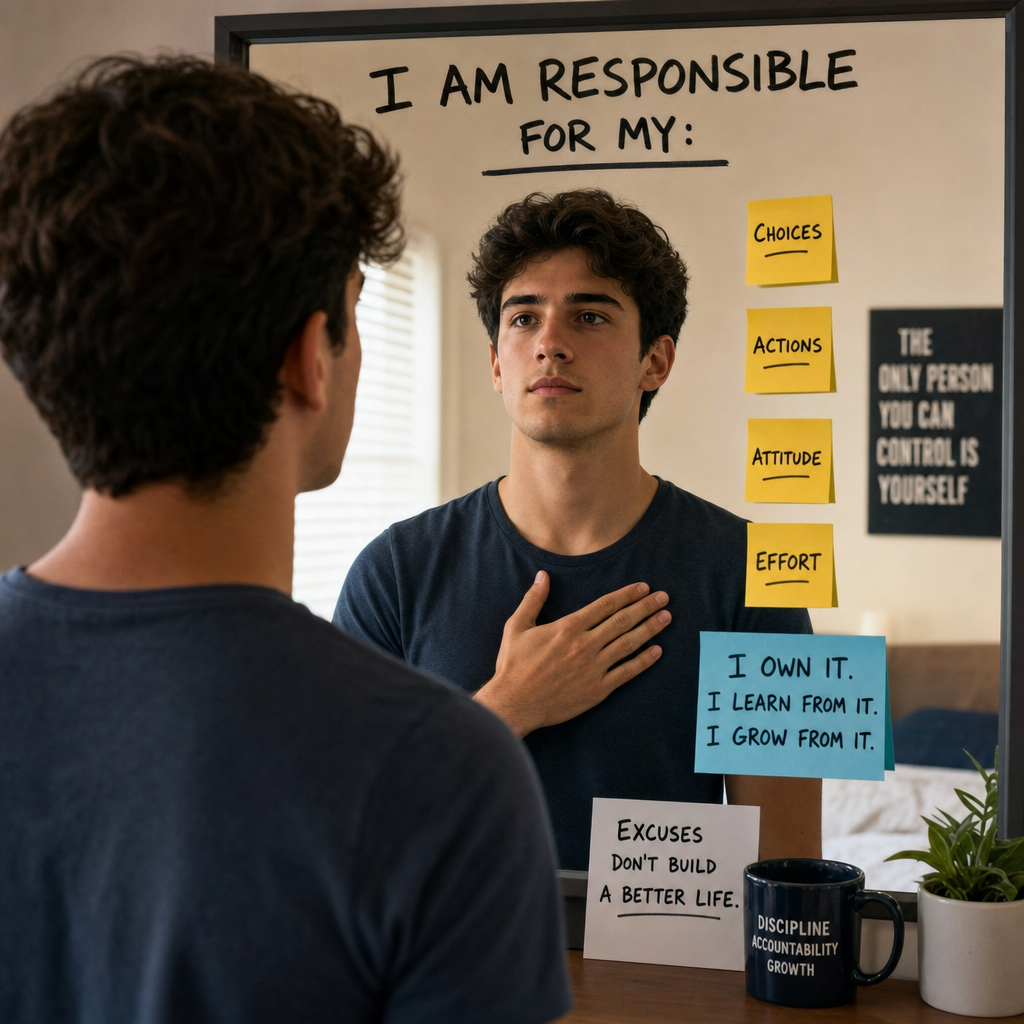
One of the most powerful lessons strength training teaches is personal responsibility.
That does not mean blaming yourself for everything. Life is complex. People face different challenges, genetics, schedules, injuries, stress levels, financial realities, and family responsibilities.
But personal responsibility means recognizing what is within your control and acting on it.
You may not control every outcome, but you can control many inputs:
- What time you go to bed
- Whether you prioritize protein at meals
- How often you train
- How you respond after a missed workout
- Whether you plan ahead or wing it
- How you talk to yourself
- Whether you ask for help when needed
This mindset is empowering because it moves you out of helplessness and into action.
Instead of saying, “I just don’t have time,” you start asking, “How can I make 30 minutes available three times this week?”
Instead of saying, “I always fall off track,” you ask, “What system would help me stay consistent?”
Instead of saying, “My schedule is too busy to eat well,” you ask, “What are three simple meals I can repeat?”
That shift matters.
The strongest people I have coached are not the ones with perfect circumstances. They are the ones who take ownership of the next best step.
Strength Training Builds Trust in Yourself
Confidence is often misunderstood. Many people think confidence is something you need before you act.
In reality, confidence usually comes after action.
Every time you complete a workout you did not feel like doing, you build self-trust. Every time you prepare a healthy meal instead of defaulting to fast food, you reinforce a new identity. Every time you add five pounds to a lift, improve your form, or recover from a setback, you collect proof that you can improve.
That proof matters.
A strong, healthy body is built through thousands of small votes for the person you want to become. Those votes might look like:
- Getting to the gym after work
- Choosing water before another sugary drink
- Walking after dinner
- Stopping a set with good form instead of ego lifting
- Going to bed instead of scrolling for another hour
- Tracking your food for awareness, not punishment
- Stretching because your body needs care
These actions may seem small, but they are identity-building.
You begin to think, “I am someone who follows through.”
That belief changes everything.
When you trust yourself in the gym, you become more likely to trust yourself in business conversations, family decisions, difficult negotiations, and personal goals. You stop waiting to feel ready. You know you can start, learn, adapt, and improve.
Discipline Beats Motivation
Motivation is helpful, but it is unreliable.
Some days you will feel fired up. Other days you will feel tired, distracted, stressed, or simply uninterested. If your health depends entirely on motivation, your results will always be inconsistent.
Discipline is different. Discipline is the ability to act according to your values, not just your feelings.
Strength training gives you a practical environment to practice discipline.
You set a plan. You show up. You warm up. You lift. You recover. You repeat.
Not because every session is exciting, but because the outcome matters.
This is also how effective leadership works. Good leaders do not only make decisions when it is easy. They follow principles. They keep commitments. They communicate clearly. They do the necessary work even when nobody is applauding.
To build discipline in your fitness routine, start with these strategies:
- Set a minimum standard: For example, “I train three times per week for 45 minutes.”
- Schedule workouts like meetings: Put them on your calendar and protect the time.
- Remove friction: Pack your gym bag the night before or train at home if travel is a barrier.
- Use a written plan: Do not rely on random workouts.
- Track completion: A simple checkmark on a calendar can be highly motivating.
- Focus on consistency first: Build the habit before chasing advanced programming.
The benefit is not just better fitness. It is becoming the kind of person who does what they said they would do.
That is character.
The Gym Teaches Humility
Strength training has a way of keeping people honest.
You can say you want to bench press more, deadlift more, improve your pull-ups, or lose 20 pounds. But the body responds to what you repeatedly do, not what you say you value.
That can be uncomfortable, but it is also useful.
The gym gives you clear feedback:
- The weight either moves or it does not.
- Your technique is either solid or it needs work.
- Your recovery is either supporting progress or limiting it.
- Your nutrition is either aligned with your goal or slowing you down.
This feedback is not personal. It is information.
Humility allows you to use that information instead of defending against it.
For example, if your squat is not improving, humility helps you ask:
- Am I training consistently?
- Is my technique efficient?
- Am I sleeping enough?
- Am I eating enough protein and calories?
- Am I trying to progress too fast?
- Do I need coaching?
The same mindset applies in leadership. Humble leaders are willing to learn. They seek feedback. They admit when a strategy is not working. They adjust instead of pretending.
Strength training teaches you to respect the process. You cannot fake adaptation. You cannot negotiate with physiology. You can only train, recover, learn, and improve.
That lesson builds maturity.
Resilience Comes From Reps
Everyone loves progress when it is smooth. But real growth includes setbacks.
You may miss workouts because of travel, illness, family responsibilities, busy seasons at work, or unexpected stress. You may deal with an injury. You may hit a plateau. You may lose momentum after a vacation or holiday.
This is normal.
The difference between people who succeed long-term and those who stay stuck is not that successful people avoid setbacks. It is that they return faster.
Strength training builds resilience because it teaches you how to restart.
A resilient mindset sounds like this:
- “I missed two workouts, but I can train today.”
- “My nutrition was off this weekend, but my next meal can be solid.”
- “I lost some strength during a stressful month, but I can rebuild.”
- “This injury is frustrating, but I can train around it safely.”
- “I do not need perfection. I need the next right action.”
This approach is especially important if you want lifelong health.
All-or-nothing thinking is one of the biggest obstacles to sustainable fitness. People often believe that if they cannot do the full workout, follow the perfect meal plan, or train five days a week, they have failed.
That is not true.
A 20-minute workout still counts. A high-protein breakfast still counts. A walk still counts. Going to bed on time still counts.
Resilience is built by continuing to participate in your own growth, even when conditions are not ideal.
That is also a leadership skill. People trust leaders who can stay calm, adapt, and keep moving forward when plans change.
Nutrition Is a Leadership Habit
Nutrition is often where people struggle most because food is emotional, social, convenient, and tied to years of habit.
But improving nutrition does not require perfection. It requires structure.
The way you feed yourself sends a message. It tells your body whether you are preparing it to perform or asking it to run on fumes. It tells your mind whether you are reacting to cravings and convenience or making intentional choices.
This is where personal responsibility becomes practical.
You do not need to eat like a professional athlete. Most people can make excellent progress by mastering the basics:
- Eat protein at each meal.
- Include fruits or vegetables daily.
- Drink enough water.
- Plan meals before you are starving.
- Keep highly tempting foods out of your main environment.
- Eat mostly whole, minimally processed foods.
- Leave room for enjoyable foods in reasonable portions.
A simple performance-based plate might include:
- Protein: Chicken, fish, lean beef, eggs, Greek yogurt, tofu, beans, or protein powder
- Carbohydrates: Rice, potatoes, oats, fruit, whole-grain bread, or pasta
- Healthy fats: Avocado, olive oil, nuts, seeds, or whole eggs
- Color: Vegetables, berries, leafy greens, peppers, carrots, or other produce
The benefits of better nutrition show up quickly:
- More stable energy
- Better training performance
- Improved recovery
- Reduced cravings
- Better mood
- Improved body composition
- Greater mental clarity
Food is not just about looking better. It is about leading your day with energy instead of dragging yourself through it.
Strong People Set Standards
One of the biggest character shifts that happens through strength training is the development of standards.
Standards are different from goals.
A goal might be, “I want to lose 25 pounds.”
A standard is, “I train three times per week, eat protein with every meal, and walk daily.”
Goals give you direction. Standards shape your behavior.
If you only focus on goals, you may become frustrated when progress feels slow. But if you focus on standards, you can win every day by acting in alignment with the person you want to become.
Strong people set standards for:
- How they move
- How they eat
- How they sleep
- How they speak to themselves
- How they recover
- How they respond to stress
- How they keep commitments
This does not mean being rigid or obsessive. It means knowing what matters and building your life around it.
For example, a healthy standard might be:
- “I do not miss more than two planned workouts in a row.”
- “I keep easy protein options at home.”
- “I walk for 10 minutes after lunch.”
- “I go to bed by 10:30 on weeknights.”
- “I warm up properly before lifting heavy.”
- “I do not use one bad meal as an excuse for a bad week.”
These standards remove decision fatigue. You do not have to debate every choice. You already know the kind of person you are practicing to become.
That is powerful.
Leadership Begins With Self-Leadership
Before you can lead others well, you have to lead yourself.
Self-leadership means directing your own behavior toward your values and goals. It is the ability to make decisions today that your future self will thank you for.
Strength training is one of the clearest ways to practice self-leadership because the feedback loop is direct. If you train with intention, eat well, sleep enough, and stay consistent, your body changes. If you neglect those inputs, your progress slows.
Self-leadership in fitness looks like:
- Planning your week before it starts
- Choosing exercises that match your goals
- Training with good form instead of ego
- Eating to support performance
- Taking rest days seriously
- Asking for guidance when you need it
- Keeping your long-term health in mind
In life, self-leadership looks like:
- Managing your time
- Setting boundaries
- Communicating clearly
- Following through
- Staying composed under pressure
- Taking ownership of your choices
- Continuing to learn
The overlap is obvious.
A person who leads themselves well physically often becomes more effective emotionally, professionally, and relationally. They have practiced doing hard things. They have practiced delaying gratification. They have practiced staying consistent when results are not immediate.
That kind of person is easier to trust.
The Confidence of Capability
There is a unique confidence that comes from being physically capable.
It is not arrogance. It is not about showing off. It is the quiet confidence of knowing your body can do things.
You can carry groceries without strain. You can hike on vacation. You can play with your kids. You can move furniture. You can handle a long day without feeling completely drained. You can walk into the gym and know what to do.
Capability changes how you experience life.
A strong and healthy body gives you more options. It expands your world.
You may notice benefits such as:
- Better posture and presence
- Less fear around physical tasks
- More energy for work and family
- Greater willingness to try new activities
- Better stress tolerance
- Improved self-image
- More confidence in social and professional settings
This is one reason strength training is so valuable for leaders. Leadership requires energy. It requires presence. It requires the ability to stay engaged when demands are high.
If your body is constantly tired, inflamed, undernourished, or weak, leadership becomes harder. You may become more reactive, less patient, and less focused.
When your body is strong, you have a better platform to show up well.
How to Build Strength That Transfers to Life
If you want strength to shape your character and leadership, do not overcomplicate the process. Start with a program you can repeat consistently.
Here is a simple framework.
Train 3 to 4 Days per Week
Most people can make excellent progress with three to four strength sessions per week.
Focus on major movement patterns:
- Squat: Goblet squat, back squat, leg press, split squat
- Hinge: Deadlift, Romanian deadlift, hip thrust
- Push: Push-up, bench press, overhead press
- Pull: Row, pull-up, pulldown
- Carry: Farmer’s carry, suitcase carry
- Core: Plank, dead bug, Pallof press
A sample three-day structure:
Day 1
- Squat variation
- Bench press or push-up
- Row
- Romanian deadlift
- Plank
Day 2
- Deadlift or hip thrust
- Overhead press
- Pulldown or assisted pull-up
- Split squat
- Farmer’s carry
Day 3
- Leg press or front squat
- Incline press
- Cable row
- Hamstring curl
- Core rotation exercise
Keep the plan simple enough to execute and challenging enough to grow.
Progress Gradually
Progressive overload means increasing the challenge over time. That can happen by:
- Adding weight
- Doing more reps
- Adding a set
- Improving range of motion
- Slowing the tempo
- Improving technique
- Reducing rest slightly
Do not rush. Strength built gradually is more sustainable and safer.
A good rule: leave one to three reps “in the tank” on most working sets. You should challenge yourself without turning every set into a maximum-effort test.
Prioritize Recovery
Training is the stimulus. Recovery is when adaptation happens.
To recover well:
- Sleep 7 to 9 hours when possible.
- Eat enough protein.
- Stay hydrated.
- Take rest days.
- Manage stress.
- Warm up before training.
- Avoid maxing out too often.
Many driven people struggle here because they think more is always better. It is not.
Better is better.
Leaders understand resource management. Your body is one of your most important resources. Treat it accordingly.
Habits That Make Strength Sustainable
The best fitness plan is the one you can actually live with.
If your plan requires extreme restriction, daily two-hour workouts, or a complete lifestyle overhaul overnight, it probably will not last.
Instead, build habits that fit your real life.
Start With Keystone Habits
Choose habits that create positive ripple effects:
- Train three days per week.
- Eat 25 to 40 grams of protein at breakfast.
- Walk 7,000 to 10,000 steps per day.
- Prepare two simple meals in advance.
- Set a consistent bedtime.
- Drink water before coffee or soda.
- Plan workouts every Sunday.
These habits are not flashy, but they work.
Use Environment Design
Your environment shapes your behavior more than willpower does.
Make healthy actions easier:
- Keep workout clothes visible.
- Put fruit on the counter.
- Store protein options at eye level.
- Keep a water bottle nearby.
- Place your phone away from your bed.
- Choose a gym close to home or work.
- Keep resistance bands or dumbbells at home.
Make unhealthy defaults harder:
- Do not keep trigger foods in bulk.
- Turn off food delivery app notifications.
- Avoid working next to snacks.
- Set limits on late-night screen time.
Good leaders design systems. Your health needs systems too.
Plan for Obstacles
Do not wait for life to become calm. Build a plan that can survive reality.
Ask yourself:
- What will I do if I miss a workout?
- What is my travel workout?
- What are my go-to restaurant orders?
- What meals can I make in under 10 minutes?
- Who can support my goals?
- What usually knocks me off track?
Then create backup plans.
For example:
- If you miss the gym, do 20 minutes at home.
- If you are traveling, walk daily and do bodyweight circuits.
- If you eat out, prioritize protein and vegetables.
- If work gets busy, reduce training volume but keep the habit alive.
This is personal responsibility in action: not controlling everything, but preparing for what you can.
What You Can Expect When You Commit
If you apply these principles consistently, you can expect changes in both your body and your life.
Physically, you may experience:
- Increased strength
- Better muscle tone
- Improved body composition
- More energy
- Better posture
- Reduced aches and pains
- Improved endurance for daily tasks
- Better sleep
- Stronger bones and joints
Mentally and emotionally, you may notice:
- Higher confidence
- Better stress management
- More patience
- Stronger self-discipline
- Improved focus
- Greater resilience
- Less anxiety around health
- More pride in your daily choices
In leadership and relationships, you may see:
- More consistency
- Better follow-through
- Clearer boundaries
- Greater presence
- More calm under pressure
- Increased credibility
- Better decision-making
The key is to understand that these benefits come from the process, not just the outcome.
The process of becoming stronger forces you to become more honest, more consistent, and more intentional. Those traits follow you everywhere.
Common Mistakes to Avoid
As you build strength, avoid these common traps.
Doing Too Much Too Soon
Ambition is good. Impatience is not.
If you go from doing nothing to training six days per week, cutting calories aggressively, and changing every habit at once, burnout is likely.
Start with a plan you can sustain. Add more only when your foundation is solid.
Chasing Perfection
Perfection is not required. In fact, chasing it often leads to quitting.
Aim for consistency over perfection. A good week executed 80% well is far better than a perfect plan abandoned after five days.
Ignoring Technique
Strength should be built on quality movement.
Poor form may let you lift more today, but it can cost you progress later. Learn proper technique, use appropriate loads, and consider working with a qualified coach if you are unsure.
Underestimating Nutrition
You cannot out-train poor nutrition forever.
If you want to build muscle, lose fat, improve performance, and feel better, food matters. Keep it simple, but take it seriously.
Neglecting Sleep
Sleep is not optional recovery. It is essential.
Poor sleep can affect hunger, hormones, mood, performance, and decision-making. If you want to lead well and train hard, protect your sleep.
A Simple 30-Day Strength and Character Challenge
If you want to put this into practice, start with a 30-day challenge.
For the next month, commit to these five actions:
1. Strength train three times per week
- Use a simple full-body plan.
- Track your exercises, sets, reps, and weights.
2. Eat protein at every meal
- Aim for a palm-sized serving or more.
- Choose options you enjoy and can repeat.
3. Walk daily
- Start with 20 minutes or a step goal that fits your current level.
- Use walks to reduce stress and improve recovery.
4. Set a sleep boundary
- Choose a realistic bedtime.
- Reduce screens 30 minutes before bed if possible.
5. Review your week every Sunday
- What went well?
- What got in the way?
- What is the plan for next week?
At the end of 30 days, do not only measure weight or appearance. Ask better questions:
- Did I keep promises to myself?
- Do I feel more capable?
- Is my energy improving?
- Am I handling stress better?
- Did I become more consistent?
- What did I learn about myself?
Those answers reveal the deeper value of strength.
Final Thoughts: Be Strong and Do Good
A strong and healthy body is not just a fitness goal. It is a leadership advantage and a character-building practice.
Strength training teaches you to take ownership, show up consistently, recover from setbacks, and make better decisions. Nutrition teaches you to fuel your body with intention. Recovery teaches you to respect your limits. Progress teaches you patience. Setbacks teach you resilience.
Over time, you become more than someone who works out.
You become someone who follows through.
You become someone who can be trusted with hard things.
You become someone who leads by example.
That is the real power of strength. It shapes not only what your body can do, but who you become in the process.