
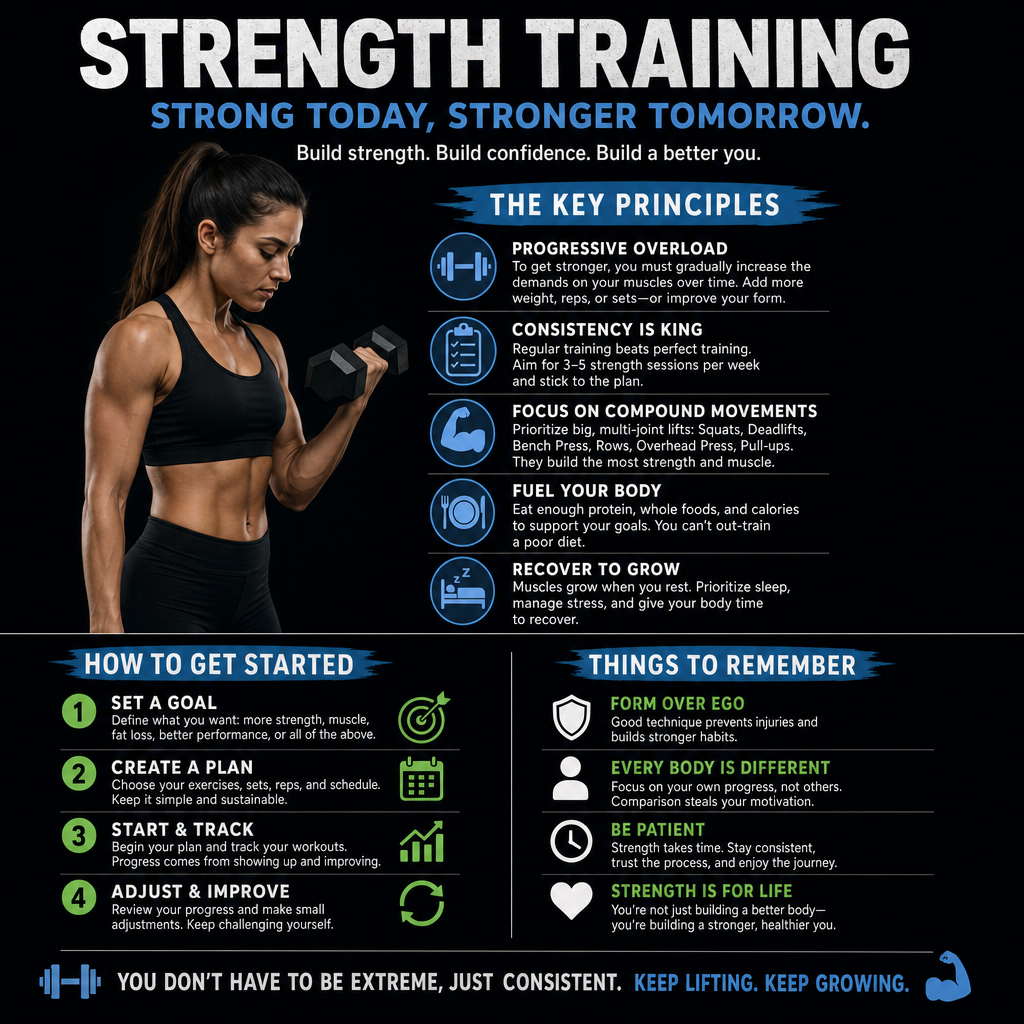
Most men walk into the gym with good intentions.
They want to get stronger. Build muscle. Lose the gut. Feel more confident. Move better. Look better in a T-shirt. Maybe keep up with their kids, perform better at work, or stop feeling like their body is aging faster than it should.
But after coaching men for over a decade, I can tell you the hard truth:
Most men do not need a more complicated workout plan. They need to stop ignoring the basics long enough for them to work.
That may not sound exciting, but it is the difference between spinning your wheels for years and building a body that is strong, capable, and healthy for life.
A strong body is not built by random workouts, ego lifting, weekend warrior bursts, or chasing soreness. It is built through consistency, smart progression, good recovery, better nutrition, and honest self-assessment.
If you are serious about experiencing life with a strong and healthy body, this article will give you practical, no-fluff strength training advice you can start using right away.
Most Men Train Hard Enough Sometimes, But Not Consistently Enough
A lot of men are capable of intense effort. That is not usually the issue.
The issue is that their effort is inconsistent.
They train hard for two weeks, then disappear for ten days. They start a new program every month. They go all-in on Monday, crush themselves, then feel too sore or too busy to train again until Friday. They treat training like a short-term challenge instead of a long-term investment.
Strength is not built from occasional intensity. It is built from repeated exposure.
Your body adapts to what you consistently ask it to do. If you ask it to lift progressively heavier weights, move through full ranges of motion, recover well, and show up multiple times per week, it will respond.
If you ask it to survive random punishment once in a while, it will mostly get sore and tired.
What to do instead
Start by choosing a realistic training schedule you can maintain for at least 12 weeks.
For most men, that means:
- 3 full-body strength sessions per week
- Or 4 sessions using an upper/lower split
- 45 to 75 minutes per workout
- At least one day of rest between hard sessions for the same muscle groups
If your schedule is packed, three focused workouts per week will outperform five theoretical workouts you cannot consistently complete.
The benefit
When you train consistently, your progress becomes measurable. You will notice:
- More strength on key lifts
- Better muscle definition
- Improved energy
- Less joint stiffness
- More confidence in your body
- Better momentum with nutrition and lifestyle habits
Consistency is not flashy, but it is the foundation that makes everything else work.
Strength Training Advice Most Men Avoid: Stop Maxing Out All the Time
One of the biggest mistakes men make is treating every workout like a test.
They walk into the gym and ask, “How much can I lift today?”
That mindset creates problems.
Testing strength and building strength are not the same thing. If you constantly max out, grind reps, and chase personal records every session, your joints, nervous system, and recovery capacity eventually hit a wall.
The strongest men in the gym usually do not train at their absolute limit every day. They train with purpose. They practice quality reps. They gradually increase workload. They know when to push and when to leave a little in the tank.
Use effort wisely
A practical way to manage your training is to use the concept of “reps in reserve,” often called RIR.
If you finish a set and feel like you could have done two more good reps, that is **2 reps in reserve**.
For most strength and muscle-building work, aim for:
- 1 to 3 reps in reserve on most working sets
- Occasional hard sets close to failure
- Very few true max attempts
- No sloppy grinder reps as a regular habit
This keeps training productive without turning every session into a recovery crisis.
When should you test your strength?
Testing has a place. But it should be planned.
Consider testing a heavy single, triple, or rep max every:
- 8 to 12 weeks for experienced lifters
- 12 to 16 weeks for newer lifters
- Only after a period of structured training
- Only when sleep, nutrition, and recovery are solid
The benefit
When you stop maxing out all the time, you usually get stronger faster because you can train more consistently. Your technique improves, your joints feel better, and you reduce the risk of setbacks.
That is smart training.
Your Form Matters More Than Your Ego
Every gym has the guy who adds weight before he earns it.
His squat gets shallower. His bench press turns into a shoulder-destroying bounce. His deadlift looks like a negotiation between his spine and gravity. He may be moving weight, but he is not building the kind of strength that lasts.
Strength training should make your body more useful, not more broken.
Good form is not about looking perfect for social media. It is about creating tension in the right places, moving through a controlled range of motion, and making the target muscles do the work.
Focus on these form principles
You do not need to overcomplicate technique, but you do need to respect it.
Before adding weight, ask yourself:
- Can I control the lowering phase?
- Can I move through a consistent range of motion?
- Do I feel the intended muscles working?
- Can I maintain a stable torso?
- Are my joints tracking well?
- Would this rep look the same if I filmed it?
If the answer is no, the weight is probably too heavy.
Use video as feedback
One of the simplest coaching tools is your phone.
Record a set from the side or a slight angle. Look for obvious issues:
- Knees caving hard during squats
- Hips shooting up early on deadlifts
- Elbows flaring aggressively on bench press
- Excessive lower-back arching on overhead presses
- Shortened range of motion as the set gets harder
You do not need to obsess over every detail, but you should be willing to learn from what you see.
The benefit
Better form helps you:
- Train the right muscles
- Build balanced strength
- Reduce injury risk
- Improve confidence under load
- Make lighter weights more effective
- Progress for years instead of months
Your ego may want more plates. Your future self wants better reps.
Listen to your future self.
Progressive Overload Is Non-Negotiable
If you want to get stronger, your training must become more challenging over time.
That principle is called progressive overload.
Many men think progressive overload only means adding weight to the bar. That is one method, but it is not the only one.
You can also progress by:
- Adding reps with the same weight
- Adding sets
- Improving range of motion
- Improving control
- Reducing rest slightly
- Increasing training frequency
- Lifting the same weight with better technique
- Using a harder variation
The goal is not to destroy yourself. The goal is to give your body a reason to adapt.
A simple progression method
Here is a practical approach that works well for most men.
Choose a rep range, such as 6 to 10 reps.
Let’s say you are doing dumbbell bench presses for 3 sets.
- Week 1: 70 lb dumbbells for 8, 7, 6
- Week 2: 70 lb dumbbells for 8, 8, 7
- Week 3: 70 lb dumbbells for 9, 8, 8
- Week 4: 70 lb dumbbells for 10, 9, 8
- Week 5: 70 lb dumbbells for 10, 10, 10
- Week 6: Move to 75 lb dumbbells and repeat the process
This is simple, measurable, and effective.
Track your workouts
If you are not tracking, you are guessing.
You do not need a fancy app. A notebook, spreadsheet, or notes app is enough.
Record:
- Exercise
- Sets
- Reps
- Weight
- Rest time if relevant
- How the set felt
- Any pain or technique notes
The benefit
Tracking and progressing your training gives you clear feedback. You will know when you are improving, when you are stuck, and when you need to adjust.
This is one of the most underrated pieces of strength training advice because it removes emotion from the process. The numbers tell the story.
Muscle Is Built Outside the Gym Too
Training creates the signal. Recovery allows the adaptation.
Many men love the training part but ignore the recovery part. They sleep five hours, eat like a teenager, live under constant stress, and wonder why their lifts stall.
You cannot out-train poor recovery forever.
At some point, your body collects the bill.
Prioritize sleep
Sleep is one of the most powerful performance enhancers available, and it is free.
Aim for:
- 7 to 9 hours per night
- A consistent sleep and wake time
- A cool, dark room
- Less screen time before bed
- Caffeine cut off 8 to 10 hours before sleep
- Give your body the minerals it needs to produce sleep hormones
Poor sleep affects testosterone, appetite, mood, coordination, reaction time, and recovery. If you are serious about strength, sleep is not optional.
Manage stress
Stress is not just mental. It affects your training too.
Work deadlines, family pressure, financial concerns, and poor sleep all add to your total stress load. Your body does not separate “gym stress” from “life stress” as neatly as you might think.
If life is unusually stressful, you may need to adjust training temporarily.
That could mean:
- Reducing volume
- Keeping more reps in reserve
- Taking longer rest periods
- Doing mobility work
- Walking more
- Avoiding max attempts
That is not weakness. That is strategy.
The benefit
Better recovery leads to:
- Stronger workouts
- Fewer nagging aches
- Better hormone function
- Improved mood
- Better decision-making around food
- More sustainable long-term progress
You do not grow stronger just because you train hard. You grow stronger because you train hard and recover well.
Nutrition Is Not a Side Project
If your training is the engine, nutrition is the fuel and building material.
A lot of men want to build muscle and lose fat at the same time, but their eating habits are chaotic. They skip breakfast, grab fast food, under-eat protein, snack at night, drink too much on weekends, and call it “balance.”
Your nutrition does not need to be perfect, but it does need to support your goal.
Start with protein
Protein is essential for muscle repair, growth, and satiety.
A strong target for most active men is:
0.7 to 1 gram of protein per pound of goal body weight per day
If your goal body weight is 180 pounds, aim for about 125 to 180 grams of protein daily.
Good protein sources include:
- Chicken
- Turkey
- Lean beef
- Eggs and egg whites
- Greek yogurt
- Cottage cheese
- Fish
- Protein powder
- Tofu or tempeh
- Beans and lentils
Build better meals
A simple meal structure works well:
- Protein: palm-sized portion or more
- Vegetables or fruit: 1 to 2 servings
- Carbohydrate: rice, potatoes, oats, fruit, pasta, beans, or whole grains
- Fat: olive oil, avocado, nuts, seeds, or whole eggs
You do not need to eat “clean” all the time. But most of your meals should look like they were built by an adult who cares about his body.
Match calories to the goal
Your calorie intake should match your primary goal.
If your goal is fat loss:
- Create a moderate calorie deficit
- Keep protein high
- Continue lifting heavy
- Avoid crash dieting
If your goal is muscle gain:
- Eat a small calorie surplus
- Gain weight slowly
- Keep training performance moving up
- Do not use “bulking” as an excuse to eat recklessly
If your goal is body recomposition:
- Keep calories around maintenance
- Prioritize protein
- Train consistently
- Be patient
The benefit
When nutrition supports training, everything improves:
- Better muscle growth
- Easier fat loss
- More stable energy
- Less hunger
- Better recovery
- Improved blood markers
- More control over your body composition
However, keep in mind that you cannot build a strong body if your digestive system can’t break down and absorb the nutrients you eat. Make sure your body has the enzymes it needs to process all the protein you eat.
Cardio Is Not the Enemy
Some men avoid cardio because they think it will kill their gains.
That belief is outdated.
Smart cardiovascular training improves your health, work capacity, recovery, and ability to handle more training. It also supports heart health, which matters if your goal is to live well, not just lift well.
You do not need to become a marathon runner. But you should be able to climb stairs, hike with your family, play a sport, or handle a demanding day without feeling wrecked.
Add low-intensity cardio
Start with walking.
It is simple, accessible, and effective.
Aim for:
- 7,000 to 10,000 steps per day
- Or 25 to 45 minutes of brisk walking most days
You can also use:
- Cycling
- Rowing
- Swimming
- Incline treadmill
- Rucking
- Easy jogging if your joints tolerate it
Use high-intensity work carefully
Intervals can be useful, but they are also more demanding.
One or two short sessions per week is enough for most men.
Example:
- 5-minute warm-up
- 8 rounds of 20 seconds hard, 100 seconds easy
- 5-minute cool-down
Do not add intense cardio on top of an already overwhelming strength program and poor sleep. More is not always better.
The benefit
Cardio helps you:
- Improve heart health
- Recover between sets faster
- Control body fat
- Reduce stress
- Improve energy
- Build a more capable body
A strong body should not get winded carrying groceries.
Stop Program Hopping
Program hopping is one of the most common reasons men fail to make progress.
They start a plan, get bored, see a new workout online, switch programs, then repeat the cycle. Every plan is judged after two weeks, even though meaningful strength development takes time.
Changing exercises too often makes it hard to measure progress. If every workout is different, you never give your body enough repeated practice to improve.
Stay with a program long enough
Commit to a plan for at least 8 to 12 weeks.
A solid strength program should include:
- Squat pattern
- Hip hinge pattern
- Horizontal push
- Horizontal pull
- Vertical push
- Vertical pull
- Single-leg work
- Core stability
- Loaded carries or grip work
You can use different exercises based on your body and equipment, but the movement patterns should be covered
Example weekly structure
Here is a simple three-day full-body approach:
Day 1
- Squat variation: 3 to 5 sets of 5 to 8 reps
- Bench press or push-up: 3 to 4 sets of 6 to 10 reps
- Row variation: 3 to 4 sets of 8 to 12 reps
- Romanian deadlift: 3 sets of 8 to 10 reps
- Plank: 3 sets
Day 2
- Deadlift variation: 3 to 5 sets of 3 to 6 reps
- Overhead press: 3 to 4 sets of 5 to 8 reps
- Pull-up or lat pulldown: 3 to 4 sets of 6 to 12 reps
- Split squat: 3 sets of 8 to 10 reps per side
- Farmer’s carry: 3 to 5 rounds
Day 3
- Front squat or leg press: 3 to 4 sets of 6 to 10 reps
- Incline dumbbell press: 3 to 4 sets of 8 to 12 reps
- Cable row or chest-supported row: 3 to 4 sets of 8 to 12 reps
- Hip thrust or hamstring curl: 3 sets of 10 to 15 reps
- Side plank or anti-rotation press: 3 sets
Run that for 12 weeks while tracking your lifts, eating enough protein, and sleeping properly. You will be surprised how effective “boring” can be.
The benefit
Sticking with a program helps you:
- Build skill in key movements
- Track progress accurately
- Avoid wasted effort
- Reduce decision fatigue
- Stay focused long enough to adapt
The best program is not the one that entertains you. It is the one you execute consistently and progress over time.
Mobility Matters, But It Will Not Save You From Weakness
Mobility work has value. If your ankles, hips, shoulders, or upper back are stiff, improving movement quality can help your lifting and daily life.
But many men use mobility work as a substitute for strength.
Stretching your hips for 30 minutes will not replace learning how to squat, hinge, lunge, and brace. A body that is flexible but weak is not the goal. A strong body should also be mobile and controlled.
Use mobility with purpose
Add mobility where it improves your training.
For example:
- Ankle rocks before squats
- Hip flexor mobility before lunges
- Thoracic rotations before pressing
- Shoulder controlled rotations before upper-body work
- Hamstring flossing before hinges
Keep it short and focused.
A good warm-up may include:
- 5 minutes of light cardio
- 3 to 5 dynamic mobility drills
- 2 to 4 ramp-up sets of your first lift
Strength through range
One of the best ways to improve mobility is to get stronger through a full, controlled range of motion.
Examples:
- Deep goblet squats
- Romanian deadlifts
- Split squats
- Dumbbell presses
- Rows with full reach and squeeze
- Controlled push-ups
- Loaded carries
The benefit
Smart mobility work helps you:
- Move better
- Lift more safely
- Reduce stiffness
- Improve positions under load
- Feel more athletic
Mobility is helpful. Strength is essential. You need both.
Your Habits Outside the Gym Decide Your Results
Most men overestimate what they do in the gym and underestimate what they do during the other 23 hours of the day.
You can train four hours per week and still sabotage your progress with poor daily habits.
Common progress killers include:
- Drinking too much alcohol
- Sitting all day without movement breaks
- Eating low-protein meals
- Staying up too late
- Skipping workouts when motivation dips
- Not drinking enough water
- Letting weekends erase weekday progress
Your body is always adapting to your lifestyle.
Improve one habit at a time
Do not try to fix everything at once. That usually lasts about five days.
Pick one habit and make it automatic.
Examples:
- Eat protein at breakfast
- Walk 10 minutes after lunch
- Go to bed 30 minutes earlier
- Prep two lunches for the week
- Drink water before coffee
- Train every Monday, Wednesday, and Friday
- Stop alcohol after two drinks
- Add vegetables to dinner
Once that habit is stable, add another.
Build an environment that supports you
Discipline matters, but environment wins more often than people admit.
Make better choices easier:
- Keep high-protein foods available
- Put workouts on your calendar
- Pack gym clothes the night before
- Remove trigger foods from the house
- Keep a water bottle nearby
- Train with a reliable partner
- Use reminders for walking breaks
The benefit
Better habits reduce the need for constant willpower. You become the kind of person who trains, eats well, and takes care of his body by default.
That is when the process gets easier.
Pain Is Information, Not a Badge of Honor
There is a difference between hard work and pain.
Muscle burn, effort, and fatigue are normal. Sharp pain, joint pain, nerve symptoms, and pain that changes your movement are not things to ignore.
Many men push through pain because they do not want to feel weak. Then a small issue becomes a major setback.
Training should challenge you, not punish you.
Use the traffic light system
Here is a simple way to think about pain:
Green light:
Mild muscle discomfort, normal effort, no change in technique. Continue.
Yellow light:
Mild joint discomfort, tightness, or pain that improves as you warm up. Modify load, range of motion, or exercise selection.
Red light:
Sharp pain, worsening pain, numbness, tingling, or pain that changes your form. Stop and seek professional guidance if needed.
Modify instead of quitting
If an exercise hurts, do not assume all training is off-limits.
Try adjusting:
- Range of motion
- Grip width
- Stance
- Tempo
- Load
- Equipment
- Exercise variation
For example:
- Barbell bench press bothers your shoulders? Try dumbbell bench or push-ups.
- Back squat irritates your hips? Try goblet squats or front squats.
- Conventional deadlift hurts your back? Try trap bar deadlifts or Romanian deadlifts.
The benefit
Respecting pain keeps you training longer. The goal is not to prove toughness in one workout. The goal is to build a body that serves you for decades.
What Real Progress Looks Like
Progress is not always dramatic week to week.
Some weeks, you add weight. Other weeks, you add a rep. Sometimes, the win is showing up when life is busy. Sometimes, it is sleeping better, eating more protein, or leaving the gym feeling strong instead of crushed.
Real progress includes:
- Lifting heavier over time
- Better technique
- More muscle
- Less body fat
- Better endurance
- Improved posture
- Fewer aches
- More energy
- More confidence
- Better health markers
- A stronger identity
Do not judge your success only by the mirror or scale. Those matter, but they are not the whole picture.
A strong and healthy body changes how you experience life. You move differently. You carry yourself differently. You handle stress differently. You stop avoiding physical challenges. You trust your body again.
That is worth working for.
A Simple Action Plan for the Next 30 Days
If you want to apply this strength training advice immediately, do not wait for perfect conditions. Start with a simple plan.
For the next 30 days:
1. Train three days per week
Use full-body strength training. Focus on the major movement patterns:
- Squat
- Hinge
- Push
- Pull
- Lunge
- Carry
- Core stability
2. Track every workout
Write down your exercises, sets, reps, and weights. Try to improve one small thing each week.
3. Eat protein at every meal
Aim for 25 to 50 grams per meal, depending on your body size and goals.
4. Walk daily
Start with 20 to 30 minutes per day or work toward 7,000 to 10,000 steps.
5. Sleep like it matters
Set a consistent bedtime. Protect your sleep the same way you protect important meetings.
6. Stop chasing perfect
You do not need the perfect program, perfect diet, or perfect schedule. You need repeatable actions done consistently.
Final Thoughts: Execute Consistently to Reach Your Goals
The hard truth about strength training most men ignore is simple:
Your results are not limited by a lack of information. They are limited by a lack of consistent execution.
You do not need to train like a professional athlete. You do not need to live in the gym. You do not need extreme diets or complicated routines.
You need to master the fundamentals:
- Train consistently
- Use good form
- Progress gradually
- Eat enough protein
- Recover well
- Walk more
- Manage pain intelligently
- Stick with the plan long enough to see results
The men who get strong and stay strong are not always the most genetically gifted. They are the ones who respect the process.
Apply the basics. Track your work. Take care of your body. Repeat long enough for the results to show.
That is the kind of strength training advice that may not sound glamorous, but it works.