
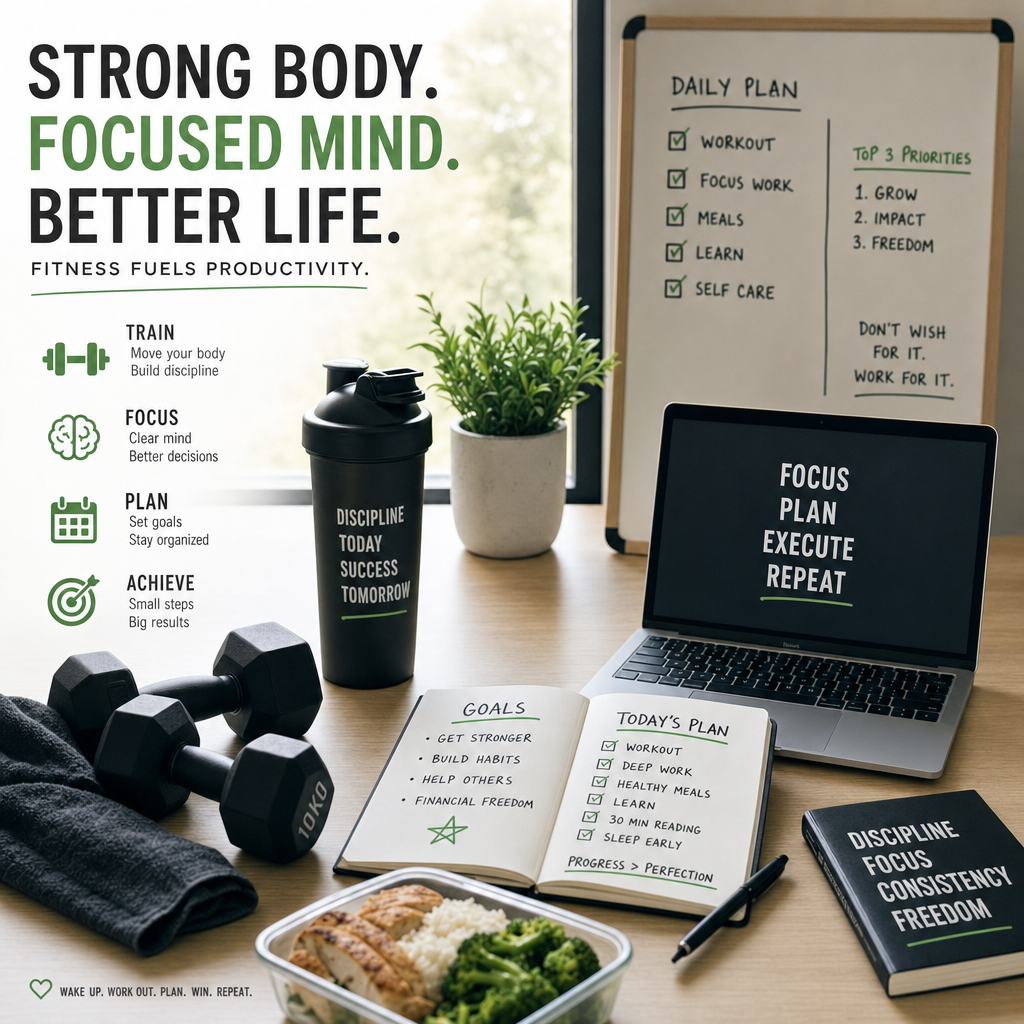
Most people understand that being fit helps you look better, feel better, and reduce your risk of disease. But there’s another benefit that doesn’t get talked about enough:
Your physical fitness can directly impact how much you earn, how well you perform, and how consistently you show up in your career or business.
After coaching clients for over a decade—from busy executives and entrepreneurs to parents, shift workers, teachers, tradespeople, and remote employees—I’ve seen the pattern repeatedly. When people improve their health, they often become sharper, more confident, more disciplined, and more resilient. Those traits tend to show up everywhere, especially at work.
This doesn’t mean you need six-pack abs or a perfect diet to be successful. It means your body is the vehicle you use to execute your ideas, serve clients, lead teams, make decisions, manage stress, and build wealth over time.
If that vehicle is tired, inflamed, under-fueled, sleep-deprived, and weak, your performance will eventually suffer.
On the other hand, when your body is strong, energized, and well-supported, your professional life gets easier. You think clearer. You handle pressure better. You communicate more effectively. You take action instead of procrastinating.
That’s the real connection between fitness and productivity.
Why Physical Fitness Is a Career Advantage
Your career is not built only on skills, degrees, experience, or networking. Those matter, of course. But your ability to consistently apply those assets depends heavily on your physical condition.
Think about a typical workday. You need to:
- Focus for long periods
- Make decisions
- Manage stress
- Communicate clearly
- Solve problems
- Handle conflict
- Stay organized
- Maintain energy from morning to evening
- Follow through on commitments
All of these require mental and physical resources.
When you’re out of shape, sleeping poorly, eating low-quality food, and rarely moving, your body has to work harder just to get through the basics. That leaves fewer resources for higher-level performance.
But when you train regularly, eat well, sleep enough, and build healthy habits, your baseline improves. You’re not relying on caffeine, urgency, or willpower to survive the day. You have more natural energy in reserve.
That reserve can translate into:
- Better work output
- More confidence in meetings
- Higher leadership presence
- Improved emotional control
- Greater consistency
- Fewer sick days
- More capacity for growth opportunities
Over time, these advantages compound.
Fitness and Productivity: How a Strong Body Helps You Perform Better
The relationship between fitness and productivity is practical, not theoretical. A stronger, healthier body supports better work performance through several key mechanisms.
1. Exercise improves energy levels
Many people avoid exercise because they feel too tired. But in most cases, the right amount of exercise actually increases energy.
Strength training, walking, cycling, swimming, and other forms of movement improve circulation and help your body use oxygen more efficiently. Regular exercise also supports better mitochondrial function—your body’s ability to produce energy at the cellular level.
In plain English: fit people tend to generate and manage energy better.
That matters when you need to perform after lunch, stay sharp during a long meeting, or make good decisions at 4:30 p.m. instead of just counting the minutes until the day ends.
2. Training builds discipline
Work success often comes down to doing what needs to be done, even when you don’t feel like it.
Fitness trains that skill.
Every time you show up for a workout, prepare a balanced meal, take a walk instead of scrolling, or go to bed on time, you reinforce self-leadership. You prove to yourself that you can follow through.
That discipline carries into work. Clients who become consistent with fitness often report that they:
- Procrastinate less
- Plan their day better
- Keep promises to themselves
- Handle hard tasks sooner
- Feel more in control of their schedule
Your body becomes a training ground for your professional habits.
3. Exercise reduces stress reactivity
Stress is unavoidable. But being constantly overwhelmed is not.
Regular physical activity helps regulate the nervous system. It gives your body a healthy outlet for tension and can reduce the intensity of stress responses over time.
This is huge for professional performance.
When you’re less reactive, you can:
- Respond instead of snap
- Think before making decisions
- Stay calm during pressure
- Communicate with more confidence
- Recover faster after setbacks
A fit body doesn’t eliminate stress. It gives you a larger container to hold it.
4. Fitness supports better brain function
Movement increases blood flow to the brain and supports cognitive functions like attention, memory, planning, and problem-solving.
Even a 10-minute walk can help clear mental fog.
That’s why some of your best ideas may come during a walk, workout, or bike ride—not while sitting at your desk forcing yourself to think harder.
If your work requires creativity, leadership, analysis, strategy, or communication, your brain is one of your most valuable assets. Fitness helps protect and enhance it.
How Poor Health Can Quietly Limit Your Income
Most people don’t connect unhealthy habits with income right away. The effects usually show up gradually.
You don’t wake up one morning and suddenly lose earning potential because you skipped workouts for a year. Instead, the cost appears in small ways:
- You feel tired during important conversations
- You avoid opportunities because your confidence is low
- You take more sick days
- You struggle to focus
- You rely on caffeine and sugar to function
- You lack the energy to learn new skills
- You avoid networking or public-facing roles
- You make impulsive decisions under stress
These small leaks can affect promotions, sales, leadership, business growth, and long-term earning power.
Energy is an economic asset
If you have more energy, you can usually produce more value.
That might mean:
- Making more sales calls
- Creating better work
- Leading your team more effectively
- Building a side business
- Studying for a certification
- Attending networking events
- Being more present with clients
- Recovering faster between demanding weeks
Energy doesn’t guarantee income, but it increases your capacity to pursue income-producing actions.
Confidence affects opportunity
When people feel uncomfortable in their bodies, they often shrink their presence. They may avoid being seen, speaking up, applying for better roles, filming content, presenting ideas, or meeting new people.
Improving your fitness can change that.
As your strength, posture, stamina, and body composition improve, confidence often rises. That confidence can influence how you carry yourself, how you speak, and how willing you are to step into bigger rooms.
In many careers, confidence is not just a personality trait. It’s a performance advantage.
Strength Training: The Foundation for a High-Performance Body
If you want the highest return on your fitness investment, strength training should be near the top of your list.
Strength training helps you build and maintain muscle, improve posture, support joint health, increase metabolism, and develop physical resilience. It also gives you a measurable way to build confidence.
You don’t need to train like a bodybuilder or powerlifter. You need a simple, progressive plan that you can follow consistently.
Benefits of strength training for work performance
Strength training can help you:
- Feel stronger and more capable
- Reduce aches from sitting
- Improve posture and presence
- Maintain energy throughout the day
- Protect your body as you age
- Improve insulin sensitivity and metabolic health
- Build confidence through visible progress
There’s also a psychological benefit: lifting weights teaches you how to handle resistance.
That lesson applies far beyond the gym.
A simple weekly strength plan
If you’re busy, start with three full-body sessions per week. Each workout can take 35–50 minutes.
Focus on these movement patterns:
- Squat: goblet squat, leg press, split squat
- Hinge: Romanian deadlift, hip thrust, kettlebell deadlift
- Push: push-up, dumbbell press, machine chest press
- Pull: row, lat pulldown, assisted pull-up
- Core: plank, dead bug, Pallof press, farmer’s carry
A simple workout could look like this:
- Goblet squat – 3 sets of 8–10 reps
- Dumbbell Romanian deadlift – 3 sets of 8–10 reps
- Push-ups or dumbbell press – 3 sets of 8–12 reps
- Seated row – 3 sets of 10–12 reps
- Plank – 3 rounds of 30–45 seconds
Start with weights that feel challenging but controlled. Add reps or weight gradually as you get stronger.
The goal is not to destroy yourself. The goal is to train in a way that improves your life.
Cardio: Your Energy and Recovery Engine
Cardio gets misunderstood. Some people think it’s only for fat loss. Others avoid it because they don’t enjoy running.
But cardiovascular fitness is about much more than burning calories. It supports heart health, work capacity, mood, recovery, and mental clarity.
If strength training builds the engine, cardio improves how efficiently that engine runs.
You don’t have to run
Choose cardio you can tolerate or even enjoy:
- Brisk walking
- Cycling
- Rowing
- Swimming
- Hiking
- Incline treadmill walking
- Dancing
- Sports
- Jump rope
- Elliptical
The best form of cardio is the one you’ll actually do.
The minimum effective dose
If you’re starting from scratch, aim for:
- 20–30 minutes of moderate cardio, 3 times per week
- Or 8,000–10,000 steps per day
- Or a combination of both
Moderate cardio should feel like you’re working, but you can still speak in short sentences.
For busy professionals, walking is often the easiest win. A 10-minute walk after meals can improve digestion, blood sugar control, mood, and focus. It also creates natural breaks in your day.
Use movement as a productivity tool
Instead of thinking of cardio as another obligation, use it strategically.
Try walking:
- Before deep work
- After stressful calls
- During brainstorming
- After lunch
- At the end of the workday to transition home
This is where fitness and productivity become very practical. Movement can help you reset your brain and return to work with better focus.
Nutrition: Fueling Your Brain, Body, and Ambition
You cannot outwork poor nutrition forever.
Food affects your energy, mood, focus, body composition, digestion, sleep, and cravings. If your diet is built around convenience foods, skipped meals, and late-night snacking, your performance may be taking a hit.
The good news: you don’t need a perfect diet. You need a repeatable structure.
Build meals around protein
Protein helps build and maintain muscle, supports recovery, keeps you full, and stabilizes energy.
Aim to include a quality protein source at most meals:
- Eggs or egg whites
- Greek yogurt
- Chicken or turkey
- Lean beef
- Fish or seafood
- Tofu or tempeh
- Cottage cheese
- Protein powder
- Beans or lentils
A good target for many active adults is roughly 0.7–1 gram of protein per pound of goal body weight per day. You don’t need to obsess, but you do need to be aware.
Add high-fiber carbohydrates
Carbs are not the enemy. The type, amount, and timing matter.
High-fiber carbs provide energy and support digestion:
- Oats
- Potatoes
- Sweet potatoes
- Rice
- Beans
- Lentils
- Fruit
- Whole-grain bread
- Quinoa
- Vegetables
If your work demands mental focus, going extremely low-carb may leave you feeling flat. Many people perform better with balanced meals that include protein, carbs, and healthy fats.
Don’t fear healthy fats
Fats support hormones, brain health, and meal satisfaction.
Choose options like:
- Avocado
- Olive oil
- Nuts
- Seeds
- Fatty fish
- Whole eggs
Portions matter because fats are calorie-dense, but they absolutely belong in a healthy diet.
Use the performance plate method
For most meals, use this simple formula:
- ½ plate: vegetables or fruit
- ¼ plate: lean protein
- ¼ plate: high-quality carbohydrate
- Add: a thumb-sized portion of healthy fat
This approach works because it’s simple, flexible, and sustainable.
You can use it at home, at restaurants, while traveling, or during a busy workday.
Hydration and Caffeine: Small Habits, Big Performance Impact
Dehydration can cause fatigue, headaches, cravings, poor concentration, and irritability. That’s not ideal when you’re trying to perform professionally.
A simple starting point: drink half your body weight in ounces of water per day.
For example, if you weigh 180 pounds, aim for about 90 ounces of water daily. You may need more if you sweat heavily, exercise often, or live in a hot climate.
Make hydration easier
Try these habits:
- Drink 16–20 ounces of water after waking
- Keep a water bottle at your desk
- Add electrolytes if you sweat a lot
- Drink water before coffee
- Have a glass of water with each meal
Use caffeine strategically
Caffeine can improve alertness, but overusing it can create dependence, anxiety, and poor sleep.
A few guidelines:
- Delay caffeine 60–90 minutes after waking if possible
- Avoid caffeine 8–10 hours before bed
- Don’t use coffee to replace sleep
- Pair caffeine with food if it makes you jittery
- Set a daily limit that doesn’t affect your sleep
Your goal is clean energy, not a stimulant roller coaster.
Sleep: The Most Underrated Performance Enhancer
If there is one habit that can transform your health and productivity quickly, it’s sleep.
Poor sleep affects hunger, cravings, testosterone, recovery, memory, emotional control, immune function, and decision-making. Even one bad night can make you more reactive and less focused.
Long term, sleep deprivation can sabotage your body composition, training progress, and professional performance.
What better sleep can do for you
Improving sleep can help you:
- Wake up with more energy
- Reduce cravings
- Improve workout recovery
- Think more clearly
- Regulate emotions
- Make better decisions
- Strengthen your immune system
- Improve motivation
If you want to earn more and perform better, protecting sleep is not lazy. It’s strategic.
Create a simple sleep routine
Start with these basics:
- Keep a consistent wake time
- Get sunlight within an hour of waking
- Stop heavy meals close to bed
- Keep your bedroom cool and dark
- Reduce screens 30–60 minutes before sleep
- Avoid late caffeine
- Use a wind-down routine: reading, stretching, journaling, or breathing
You don’t need a perfect sleep setup. You need consistent signals that tell your body it’s time to recover.
Posture, Pain, and Professional Presence
Many people spend most of their workday sitting. Over time, this can contribute to tight hips, weak glutes, rounded shoulders, neck pain, and back discomfort.
Pain is distracting. It drains energy and reduces your ability to focus.
Improving your fitness can help reduce common aches and make you look and feel more confident.
The “desk worker reset” routine
Use this quick routine once or twice daily:
- Hip flexor stretch – 45 seconds each side
- Glute bridges – 15 reps
- Band pull-aparts – 15 reps
- Wall slides – 10 reps
- Bodyweight squats – 10 reps
- Deep breathing – 5 slow breaths
This takes less than 7 minutes and can make a noticeable difference if done consistently.
Stand and move more often
Set a timer or use natural triggers:
- Stand during phone calls
- Walk while listening to meetings when possible
- Take stairs
- Park farther away
- Do 10 squats between work blocks
- Stretch after long periods of sitting
Small movement snacks throughout the day add up.
How Fitness Builds Leadership Presence
Whether you manage people, run a business, sell services, or work on a team, your physical presence matters.
Leadership presence isn’t about being the most muscular person in the room. It’s about energy, posture, confidence, composure, and clarity.
Fitness supports all of those.
When you feel strong in your body, you tend to:
- Stand taller
- Speak more confidently
- Handle pressure better
- Make stronger eye contact
- Take up space without arrogance
- Project calm and capability
People respond to energy. If you walk into a room exhausted, stressed, and uncomfortable, that communicates something. If you walk in grounded, energized, and prepared, that communicates something else.
Your body often speaks before you do.
The Compound Effect of Healthy Habits
The biggest mistake people make is underestimating small improvements.
You don’t need to overhaul your entire life in one week. In fact, trying to change everything at once usually backfires.
Instead, focus on habits that compound.
Small habits with big returns
Start with a few of these:
- Walk 10 minutes after lunch
- Train strength 3 times per week
- Eat protein at breakfast
- Drink water before coffee
- Sleep 30 minutes earlier
- Prep two easy lunches per week
- Stretch for 5 minutes after work
- Replace one sugary snack with fruit and Greek yogurt
- Take walking meetings
- Plan tomorrow’s workout before bed
These actions may look small, but they change your identity. You begin to see yourself as someone who takes care of their body and follows through.
That identity shift is powerful.
Once you become consistent with the basics, more advanced strategies become easier.
A Practical Weekly Plan for Busy Professionals
Here’s a realistic plan that supports fitness and productivity without taking over your life.
Monday
- Full-body strength workout
- Protein-focused breakfast
- 10-minute walk after lunch
- Set work priorities for the week
Tuesday
- 30-minute brisk walk or cycling
- Hydration goal: 2–3 liters of water
- Balanced meals using the performance plate
Wednesday
- Full-body strength workout
- Stretch for 5 minutes before bed
- Stop caffeine by early afternoon
Thursday
- 20–30 minutes moderate cardio
- Take one walking meeting
- Prep a simple protein option for tomorrow
Friday
- Full-body strength workout
- Review wins from the week
- Choose one active weekend plan
Saturday
- Longer walk, hike, sport, or recreational activity
- Flexible nutrition with protein included
- Spend time outside
Sunday
- Light mobility or recovery walk
- Plan workouts for the week
- Grocery shop or prep basic meals
- Set bedtime target
This plan is not extreme. That’s the point. The best fitness plan is one you can repeat during real life.
What Results Can You Expect?
When you consistently apply these habits, you can expect benefits in multiple areas.
Physical benefits
You may notice:
- More strength
- Better posture
- Improved body composition
- Less stiffness
- Better endurance
- Improved sleep quality
- Fewer energy crashes
Mental benefits
You may experience:
- Sharper focus
- Better mood
- Less stress
- More confidence
- Improved discipline
- Stronger emotional control
Professional benefits
Over time, these physical and mental improvements can support:
- Better work quality
- More consistent output
- Improved communication
- Greater leadership presence
- More capacity for responsibility
- Increased confidence pursuing opportunities
- Better long-term earning potential
Again, fitness does not magically create success. But it gives you a stronger platform to build success from.
Common Obstacles and How to Overcome Them
“I don’t have time.”
You don’t need hours per day. Start with 30–45 minutes, 3 times per week.
If that feels impossible, begin with:
- 10-minute walks
- 15-minute home workouts
- Two strength sessions per week
- Meal upgrades instead of full meal prep
Time is real, but so is priority. Your health supports everything else you’re trying to do.
“I’m too tired.”
Start easier than you think you should.
A short walk, light workout, or basic mobility session can build momentum without overwhelming you. As your fitness improves, your energy usually improves too.
“I always fall off.”
You don’t need more intensity. You need a better system.
Try:
- Scheduling workouts like meetings
- Training at the same time each day
- Keeping gym clothes visible
- Using a simple program
- Tracking workouts
- Having backup options for busy days
- Getting accountability from a coach or friend
Consistency comes from reducing friction.
“I travel a lot.”
Travel doesn’t have to derail you.
Focus on:
- Hotel gym workouts
- Bodyweight circuits
- Walking in airports
- Protein at breakfast
- Water during flights
- Grocery store meals
- Choosing restaurants with lean protein options
The goal is not perfection on the road. The goal is maintaining your standards as much as possible.
The 80/20 Approach to Fitness and Performance
If you want the biggest return from your health habits, focus on the fundamentals.
These are the 20% of actions that create 80% of the results:
- Strength train 2–4 times per week
- Walk daily
- Eat protein at each meal
- Choose mostly whole foods
- Drink enough water
- Sleep 7–9 hours when possible
- Manage stress with movement, breathing, or recovery practices
- Limit alcohol and ultra-processed foods
- Stay consistent most of the time
You do not need a complicated supplement stack, extreme diet, or two-hour daily workout routine.
Master the basics and repeat them long enough to see results.
Your Body Is Part of Your Professional Strategy
If you care about your career, business, income, leadership, and quality of life, your body cannot be an afterthought.
Your fitness affects how you think, feel, communicate, decide, recover, and perform. It influences your confidence, discipline, energy, and ability to handle stress.
That’s why the connection between fitness and productivity matters so much. A healthy body gives you more capacity to create value, pursue opportunities, and enjoy the life you’re working hard to build.
Start simple.
Lift weights a few times per week. Walk daily. Eat more protein. Drink water. Sleep better. Take breaks from sitting. Build habits you can repeat even when life is busy.
You don’t need to become a different person overnight.
You just need to make the next healthy choice—and then keep stacking those choices until strength, energy, and confidence become your normal.