
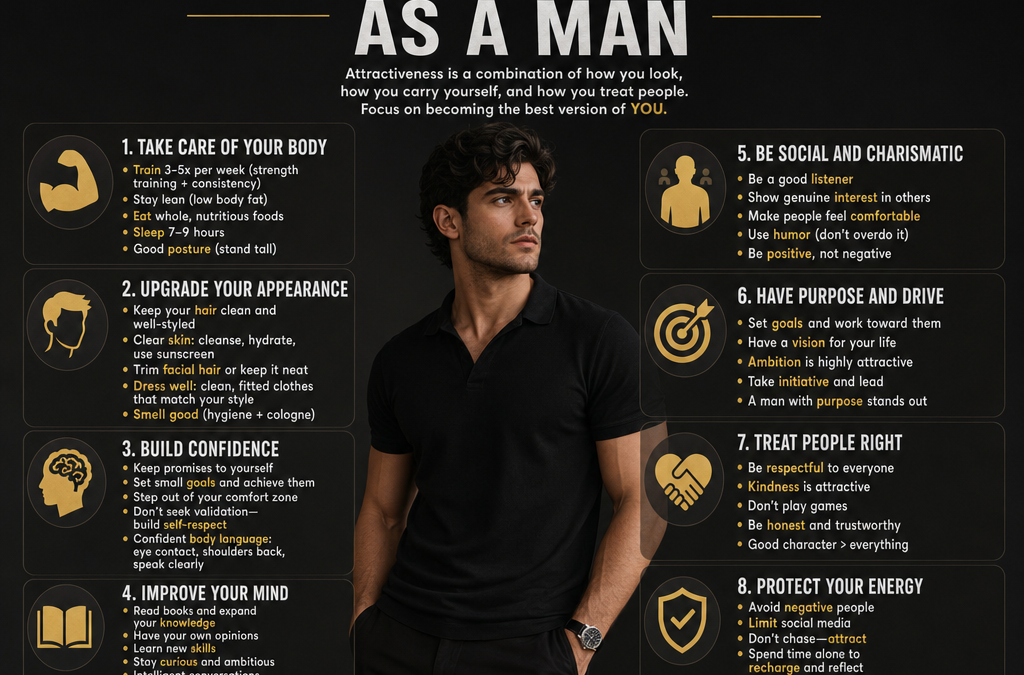
Most men who ask about attraction start in the wrong place.
They look for the perfect haircut, the right cologne, the “alpha” body language trick, or a wardrobe upgrade. Those things can help, but they are multipliers—not the foundation.
The foundation is your body.
Not just in the “look good at the beach” sense. A strong, athletic body changes how you move, how you carry yourself, how your clothes fit, how you handle stress, and how much energy you bring into a room. It affects confidence because you have daily proof that you can do hard things and keep promises to yourself.
If you want to know how to become more attractive as a man, start by building a body that communicates health, strength, discipline, and capability.
The good news: you do not need to become a bodybuilder, live in the gym, or eat plain chicken and broccoli six times a day. You need a smart training plan, simple nutrition habits, better recovery, and enough consistency to let the process work.
Below is a practical roadmap.
Attraction Starts With Health, Not Vanity
Let’s be clear: wanting to look better is not shallow.
Looking better often comes from doing things that also make you healthier:
- Lifting weights
- Eating enough protein
- Losing excess body fat
- Improving posture
- Sleeping more
- Drinking less alcohol
- Building athletic conditioning
- Managing stress
- Developing discipline
Those habits don’t just change your appearance. They change your presence.
A man who trains regularly usually stands taller, moves with more control, has better energy, and looks more capable. That matters. Women may notice broad shoulders, a lean waist, strong arms, or a confident walk—but underneath those signals is a lifestyle.
The goal is not to look like someone else. The goal is to look like the strongest, healthiest version of yourself.
How to Become More Attractive as a Man: Build the “Athletic V-Taper”
When most men think “attractive body,” they imagine huge arms or a massive chest. Those can help, but the most visually powerful male physique is usually built around an athletic V-taper:
- Wider shoulders
- Developed upper back
- Solid chest
- Leaner waist
- Strong legs and glutes
- Good posture
This combination makes you look strong without needing to be enormous. It also makes clothes fit better. T-shirts sit better on your shoulders, jackets frame your torso, and jeans look sharper when you have developed legs and glutes.
To build this look, prioritize these muscle groups:
1. Shoulders
Well-developed shoulders create width and structure.
Focus on:
- Overhead presses
- Dumbbell shoulder presses
- Lateral raises
- Rear delt flyes
- Face pulls
2. Upper Back and Lats
Your back is what gives your torso shape. It also improves posture, which instantly improves how you look.
Focus on:
- Pull-ups or assisted pull-ups
- Lat pulldowns
- Seated cable rows
- Dumbbell rows
- Chest-supported rows
3. Chest
A strong chest adds thickness and power to your upper body.
Focus on:
- Push-ups
- Bench press
- Incline dumbbell press
- Machine chest press
- Dips, if your shoulders tolerate them
4. Glutes and Legs
Do not skip legs. Strong legs improve athleticism, testosterone-supportive training output, posture, and overall balance. A man with a strong upper body and weak legs does not look athletic—he looks unfinished.
Focus on:
- Squats
- Romanian deadlifts
- Lunges
- Leg presses
- Hip thrusts
- Split squats
5. Core
You do not need endless crunches. You need a core that stabilizes your body and helps transfer force.
Focus on:
- Planks
- Hanging knee raises
- Dead bugs
- Pallof presses
- Cable chops
- Farmer’s carries
The athletic look comes from building muscle in the right places while keeping body fat under control.
Train Like You Want to Look Capable
There is a difference between exercising and training.
Exercise is random. Training is planned.
If your goal is to build a strong, athletic body, you need progressive overload. That means gradually doing more over time by increasing weight, reps, sets, or quality of movement.
You don’t need a complicated plan. You need a repeatable one.
Here is a simple four-day strength plan that works well for most men.
The 4-Day Athletic Strength Plan
Day 1: Upper Body Strength
1. Bench press or dumbbell press
4 sets of 5–8 reps
2. Pull-ups or lat pulldowns
4 sets of 6–10 reps
3. Overhead press
3 sets of 6–10 reps
4. Seated row or chest-supported row
3 sets of 8–12 reps
5. Lateral raises
3 sets of 12–20 reps
6. Triceps pushdowns
2–3 sets of 10–15 reps
7. Dumbbell curls
2–3 sets of 10–15 reps
Day 2: Lower Body Strength
1. Squat or leg press
4 sets of 5–8 reps
2. Romanian deadlift
3 sets of 6–10 reps
3. Walking lunges
3 sets of 10–12 reps per leg
4. Leg curls
3 sets of 10–15 reps
5. Standing calf raises
3 sets of 10–15 reps
6. Plank
3 rounds of 30–60 seconds
Day 3: Upper Body Hypertrophy
1. Incline dumbbell press
3 sets of 8–12 reps
2. One-arm dumbbell row
3 sets of 8–12 reps per side
3. Machine chest press or push-ups
3 sets of 10–15 reps
4. Lat pulldown
3 sets of 10–12 reps
5. Rear delt flyes
3 sets of 12–20 reps
6. Cable lateral raises
3 sets of 12–20 reps
7. Hammer curls
2–3 sets of 10–15 reps
Day 4: Lower Body and Athletic Conditioning
1. Deadlift or trap bar deadlift
3 sets of 3–6 reps
2. Bulgarian split squat
3 sets of 8–10 reps per leg
3. Hip thrust or glute bridge
3 sets of 8–12 reps
4. Leg extension
2–3 sets of 12–15 reps
5. Farmer’s carries
4 rounds of 30–40 meters
6. Conditioning finisher
8–12 minutes of sled pushes, bike intervals, rowing, or hill sprints
How Hard Should You Train?
Most sets should end with 1–3 reps left in the tank. That means you are working hard, but not destroying yourself.
A common mistake is training like every set is a life-or-death event. That leads to burnout, joint pain, and inconsistency.
Use this rule:
- If your form breaks down, the set is over.
- If the target reps feel easy, increase the weight next time.
- If you feel beat up for days, reduce volume or intensity.
- If you are never challenged, push harder.
Your body responds best to consistent stress followed by recovery.
Build Muscle First, Then Get Leaner
Many men want to lose fat and build muscle at the same time. This is possible, especially if you are newer to training, returning after time off, or carrying extra body fat.
But the priority depends on your starting point.
If you are overweight
Focus on losing fat while strength training. Your physique will change quickly because fat loss reveals your shape.
Aim for:
- A moderate calorie deficit
- High protein
- Strength training 3–4 days per week
- Daily walking
- Better sleep
If you are skinny or “skinny-fat”
Focus on building muscle first. Do not crash diet. You need to create shape.
Aim for:
- A small calorie surplus or maintenance calories
- High protein
- Progressive strength training
- Patience with fat loss
- Better meal consistency
If you are already lean but not muscular
Commit to a muscle-building phase. Accept that the scale may go up slowly.
Aim for:
- 0.25–0.5 pounds of weight gain per week
- Training performance increases
- Enough carbs to fuel workouts
- Consistent meals
The body that women actually notice is usually not just “lean.” It is lean enough to show structure and muscular enough to look strong.
Nutrition: The Simple System That Works
You do not need a perfect diet. You need a diet you can repeat.
As a coach, I’ve seen men make incredible progress by mastering a few basics instead of chasing advanced hacks.
Start With Protein
Protein helps you build muscle, recover from training, and stay full while losing fat.
A good target is:
0.7–1 gram of protein per pound of goal body weight per day.
If your goal weight is 180 pounds, aim for roughly 130–180 grams of protein daily.
Great protein sources include:
- Chicken breast or thighs
- Lean beef
- Turkey
- Eggs and egg whites
- Greek yogurt
- Cottage cheese
- Fish
- Shrimp
- Tofu or tempeh
- Protein powder
Build Each Meal Around Protein
A simple plate might look like this:
- 1–2 palms of protein
- 1 fist of carbs
- 1–2 fists of vegetables or fruit
- 1 thumb of healthy fats
Examples:
- Eggs, oatmeal, berries
- Greek yogurt, protein powder, banana, nuts
- Chicken, rice, vegetables, olive oil
- Steak, potatoes, salad
- Salmon, quinoa, asparagus
- Turkey burger, sweet potato, side salad
Control Calories Without Obsessing
Calories determine whether you gain or lose weight, but you don’t need to track forever.
Start by tracking for 2–4 weeks. This teaches you what you actually eat. After that, you can use habits and portions.
For fat loss, use these strategies:
- Eat protein at every meal
- Choose mostly whole foods
- Reduce liquid calories
- Limit snacks that are easy to overeat
- Keep alcohol to 0–2 drinks per week
- Walk after meals
- Eat slower
- Stop eating at “satisfied,” not stuffed
For muscle gain:
- Add one extra meal or snack
- Increase carbs around workouts
- Use smoothies if appetite is low
- Track body weight weekly
- Increase calories if weight is not moving
Carbs Are Not the Enemy
A lot of men try to get lean by cutting carbs aggressively. It can work short-term, but it often makes training worse and cravings stronger.
Carbs fuel hard workouts. Hard workouts build muscle. Muscle improves your shape.
Smart carb choices include:
- Rice
- Potatoes
- Oats
- Fruit
- Whole-grain bread
- Pasta
- Beans
- Quinoa
- Cereal around training, if it fits your calories
If you train hard, carbs are a tool. Use them.
A good approach:
- Eat more carbs before and after workouts.
- Eat fewer carbs on rest days if fat loss is the goal.
- Keep protein consistent every day.
Get Lean Without Looking Small
One of the biggest mistakes men make is dieting too aggressively.
Yes, a calorie deficit helps you lose fat. But if you cut too hard, you may lose muscle, crush your energy, and end up looking smaller instead of better.
For most men, a good fat-loss pace is:
- 0.5–1% of body weight per week
If you weigh 200 pounds, that is about 1–2 pounds per week.
To preserve muscle while cutting:
- Keep lifting heavy
- Maintain protein intake
- Avoid extreme calorie deficits
- Sleep 7–9 hours
- Use walking as your main fat-loss tool
- Add conditioning strategically, not excessively
Your goal is not to become lighter at all costs. Your goal is to become leaner while keeping strength and muscle.
Walking Is the Most Underrated Fat-Loss Tool
If you want a leaner, healthier body, walk more.
Walking burns calories without beating up your joints or interfering with recovery. It also improves mood, digestion, blood sugar control, and cardiovascular health.
Start with:
- 7,000 steps per day if you are currently sedentary
- 8,000–10,000 steps per day once that feels normal
- 10–15 minutes after meals when possible
Walking also builds a stronger lifestyle identity. You stop being someone who “tries to get in shape” and become someone who moves daily.
That matters.
Conditioning: Look Athletic, Not Just Muscular
Strength builds the frame. Conditioning gives you the engine.
A man who looks strong but gets winded walking up stairs does not project athleticism. You don’t need to run marathons, but you should build a base level of cardiovascular fitness.
Use two types of conditioning:
Zone 2 Cardio
This is steady, moderate-intensity cardio where you can still speak in short sentences.
Options:
- Incline walking
- Cycling
- Rowing
- Swimming
- Jogging
- Hiking
Do this 2–3 times per week for 20–40 minutes.
Benefits include:
- Better heart health
- Faster recovery
- Improved endurance
- Lower stress
- Better fat metabolism
High-Intensity Conditioning
This should be used sparingly because it is demanding.
Options:
- Sled pushes
- Hill sprints
- Assault bike intervals
- Rowing sprints
- Battle ropes
Try 1–2 sessions per week, usually after lifting or on a separate day.
Example:
- 10 rounds of 20 seconds hard, 100 seconds easy
High-intensity work makes you feel powerful and athletic, but more is not always better. Recoverability matters.
Posture Changes Everything
You can build muscle and still look less attractive if your posture is poor.
Many men sit all day, round their shoulders, crane their neck forward, and lose hip mobility. This makes the chest look smaller, the belly look bigger, and confidence look lower.
Improve posture by strengthening the muscles that pull you into better alignment.
Add these movements 2–4 times per week:
- Face pulls
- Band pull-aparts
- Rear delt flyes
- Chest-supported rows
- Dead bugs
- Hip flexor stretches
- Thoracic spine rotations
- Farmer’s carries
Also practice better daily habits:
- Keep your screen at eye level
- Stand up every 30–60 minutes
- Walk during phone calls
- Train your upper back as much as your chest
- Avoid constantly looking down at your phone
Good posture can make you look more confident almost immediately. Strong posture makes that confidence sustainable.
Sleep Is a Physique Sculpting Tool
If you sleep five hours per night, you are making fitness harder than it needs to be.
Poor sleep increases hunger, reduces testosterone, worsens recovery, lowers training performance, and makes discipline feel harder. You may still make progress, but it will be slower.
Aim for 7–9 hours most nights.
Improve sleep with simple habits:
- Keep a consistent bedtime and wake time
- Stop caffeine 8–10 hours before bed
- Keep the room cool and dark
- Avoid heavy meals right before sleep
- Reduce alcohol
- Get morning sunlight
- Put your phone away 30 minutes before bed
Sleep is not a luxury. It is when your body adapts.
If training is the stimulus, sleep is when growth happens.
Grooming, Style, and Body Composition Work Together
This article focuses on the body, but attraction is holistic. A strong physique is amplified by basic presentation.
You don’t need to become fashion-obsessed. You just need to look intentional.
Start with:
- Clothes that fit your current body
- Clean shoes
- A haircut that suits your face
- Facial hair that is shaped, not neglected
- Good skin hygiene
- Fresh breath
- A subtle fragrance
- Clean nails
As your body changes, your style options expand. Clothes fit better when your shoulders, chest, arms, and legs have shape. A leaner waist makes outfits look sharper.
This is one reason strength training is such a high-return investment. It upgrades the body underneath every outfit.
Confidence Comes From Kept Promises
A lot of men want confidence before they start. That’s backwards.
Confidence is built through evidence.
Every time you train when you said you would, eat a solid meal instead of junk, go for a walk instead of scrolling, or get to bed on time, you give yourself evidence that you are in control.
That evidence changes your self-image.
You stop thinking:
“I need motivation.”
And start thinking:
“This is what I do.”
That shift is powerful. It affects your dating life, career, friendships, and standards. You become less desperate for validation because you respect yourself more.
If you are serious about learning how to become more attractive as a man, understand this: attraction is not only about how your body looks. It is also about the kind of man your habits are building.
The 80/20 Habit Checklist
If you feel overwhelmed, start here.
Do these consistently for 12 weeks:
- Lift weights 3–4 times per week
- Eat protein at every meal
- Walk 8,000–10,000 steps per day
- Sleep 7+ hours per night
- Drink mostly water
- Limit alcohol
- Eat vegetables or fruit daily
- Track body weight 2–3 times per week
- Take progress photos every 4 weeks
- Add weight or reps in the gym over time
That is enough to transform most men.
You do not need perfection. You need consistency.
What Results Can You Expect?
Your exact results depend on your starting point, genetics, training history, diet, sleep, and consistency. But here is a realistic timeline.
After 2–4 Weeks
You may notice:
- Better energy
- Improved mood
- Less bloating
- Better sleep
- More confidence
- Early strength gains
Other people may not notice yet, but you will feel the difference.
After 8–12 Weeks
You may notice:
- Clothes fitting better
- Visible muscle changes
- Improved posture
- Fat loss around the waist
- More strength in major lifts
- Better endurance
This is when friends, coworkers, or dates may start commenting.
After 6–12 Months
You can look like a different man.
Expect:
- Broader shoulders
- Stronger arms
- Leaner waist
- Better chest and back development
- More athletic movement
- Higher confidence
- A stronger identity around health
Most men quit too early. The men who stand out are not always the most genetically gifted—they are the ones who stay consistent long enough for the work to show.
Common Mistakes That Keep Men Stuck
Avoid these if you want faster progress.
Mistake 1: Program Hopping
Changing workouts every week prevents progress. Pick a plan and run it for at least 8–12 weeks.
Mistake 2: Not Eating Enough Protein
If protein is low, muscle-building becomes harder and hunger becomes louder.
Mistake 3: Training Only Chest and Arms
Chest and arms matter, but back, shoulders, legs, and glutes create the complete athletic look.
Mistake 4: Going Too Hard Too Soon
You do not need to destroy yourself in week one. Build momentum.
Mistake 5: Ignoring Recovery
Poor sleep, high stress, and too much alcohol will slow your progress.
Mistake 6: Expecting Motivation Every Day
Motivation is unreliable. Systems win.
A Simple Weekly Schedule
Here is an example week:
Monday: Upper body strength + 20-minute walk
Tuesday: Lower body strength + mobility
Wednesday: Zone 2 cardio + steps
Thursday: Upper body hypertrophy
Friday: Lower body + conditioning finisher
Saturday: Long walk, hike, sport, or easy cardio
Sunday: Rest, meal prep, light mobility
This gives you strength, muscle, conditioning, recovery, and structure.
If four lifting days is too much, start with three. If three is too much, start with two. The best plan is the one you can actually execute.
Your First 30 Days
Here is your simple action plan.
Week 1
- Choose your workout schedule
- Take starting photos
- Track your current food intake
- Start walking 7,000 steps per day
- Eat protein at breakfast
Week 2
- Begin progressive overload
- Increase protein at lunch and dinner
- Set a sleep target
- Reduce alcohol and liquid calories
- Add one Zone 2 cardio session
Week 3
- Add 500–1,000 daily steps
- Prepare 2–3 go-to meals
- Add mobility or posture work
- Track gym performance
- Adjust calories based on your goal
Week 4
- Review your weight trend
- Take new photos
- Add weight or reps where possible
- Identify your biggest obstacle
- Plan the next four weeks
This is how transformation happens: one clear month at a time.
Final Thoughts: Develop a Body Women Actually Notice
If your goal is to build a strong, athletic body women actually notice, focus less on shortcuts and more on signals.
Strength is a signal. Health is a signal. Discipline is a signal. Energy is a signal. Posture is a signal. Confidence is a signal.
The body you build tells a story before you say a word.
Learning how to become more attractive as a man is not about chasing approval or trying to become someone you’re not. It is about upgrading the habits, health, and physical presence you bring into the world.
Lift consistently. Eat like an adult. Walk daily. Sleep enough. Build muscle. Get leaner. Carry yourself well.
Do that for long enough, and people will notice.
More importantly, you will notice.